DIS 2026 · Singapore

INTENTFLOW🌀

Supporting Interactive and Fluid Intent Communication with LLMs

Proceedings of the Designing Interactive Systems Conference (DIS '26)

Brandon Chin
Brandon ChinUC Berkeley
Juho Kim
Juho KimKAIST, SkillBench
TL;DR

Users' intents in generative AI are vague, fluid, and often subconscious — yet today's chat interfaces offer little help in expressing, refining, and tracking them over time.

From a review of 46 HCI papers, we distill four key aspects of intent communication — Articulation, Exploration, Management, and Synchronization — and build IntentFlow, a writing probe that supports all four together.

In a study (N=12), comprehensive support shifted users from repetitive correction toward verification-driven refinement, while lowering effort and frustration.

Generative AI shifts interaction toward intent-based outcome specification, despite inherently vague, fluid, and evolving intents. While HCI research has proposed diverse interaction techniques to support this process, how key aspects of intent communication interplay to shape users' workflows remains underexplored. To bridge this gap, we conduct a systematic literature review of 46 HCI papers and identify four core aspects of intent communication support: intent Articulation, Exploration, Management, and Synchronization. To investigate how these aspects interplay in practice, we developed IntentFlow, a research probe that embodies all four aspects for a writing task, and conducted a comparative study (N=12). Our action-level behavioral analysis reveals that comprehensive support enables verification-driven refinement and progressive intent curation, reduces cognitive effort, and improves users' sense of control and understanding of intent–output alignment.
From literature review

Four Key Aspects of Intent Communication

A user's goal is explicit and stable, but underlying intents — strategies, preferences, constraints — are far messier: vague, fluid, and subconscious.

We conducted a systematic literature review of 46 HCI papers on intent communication in AI-assisted systems. Across these papers, we identified 14 distinct interaction features and synthesized them into four core aspects — each capturing a different dimension of how users communicate intents with generative AI.

✏️
Intent ArticulationConvergent Process

Helping users turn vague, underspecified intents into concrete, actionable instructions.

Users often struggle to articulate what they want from an AI system. IntentFlow supports articulation by externalizing a user's prompt into a structured goal and editable low-level intents — making implicit expectations explicit so users can refine and communicate them precisely.
🔭
Intent ExplorationDivergent Process

Helping users discover new, emerging intents beyond their initial scope.

Intent exploration lets users go beyond their initial idea. IntentFlow offers adjustable intent dimensions — radio buttons, sliders, and tag selectors — that invite users to try variations and discover directions they hadn't considered, turning a single prompt into a design space.
📋
Intent ManagementStabilizing Process

Helping users organize and curate intents as they evolve.

As intents evolve over a session, keeping track of them is critical. IntentFlow lets users pin important intents and dimension values so they persist across turns, and shows a version history of the output — enabling progressive curation rather than starting over each time.
🔗
Intent SynchronizationAligning Process

Aligning user intents with AI output so users can verify each intent is realized as intended.

Misalignment between what a user intends and what the model produces is a key source of frustration. IntentFlow makes the intent–output connection transparent by linking each intent and dimension value to specific output segments — hovering on an intent highlights the corresponding text.
Research Probe

The IntentFlow System

IntentFlow is a research probe that embodies all four aspects in a single LLM-based writing workflow, organized into a Chat Panel, Intent Panel, and Output Panel.
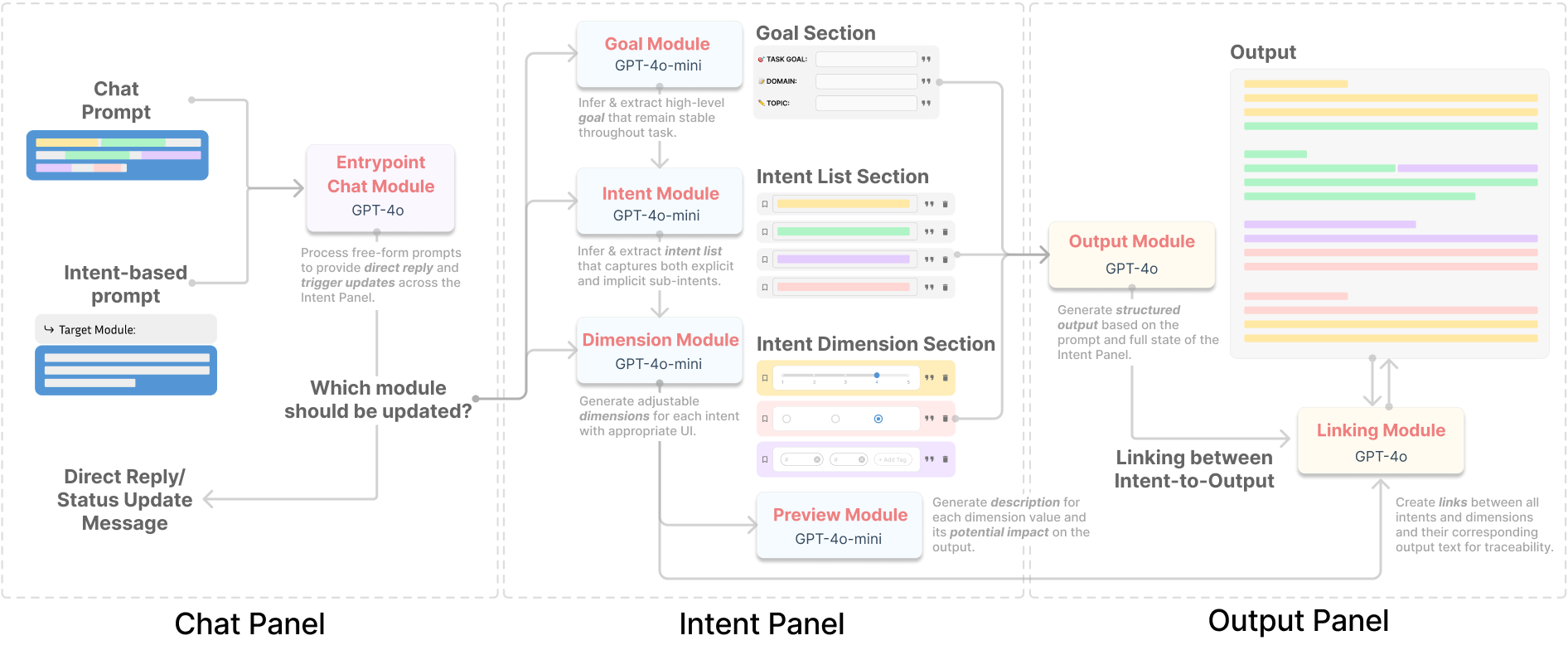
IntentFlow internal pipeline of modular LLM components
✏️
Intent Articulation
Convergent Process · Intent Panel
  • Automatically parses your chat message into a high-level goal and editable low-level intents
  • Implicit intent elements are surfaced explicitly — letting you verify what the system understood
  • Edit or remove any intent before generation to align the system's interpretation with yours
🔭
Intent Exploration
Divergent Process · Intent Panel
  • Each intent has adjustable dimensions — structured parameters like Tone, Length, or Style
  • Dimensions use radio buttons, sliders, or tag selectors to encourage low-effort variation
  • Vary dimension values freely to generate different outputs without rewriting prompts from scratch
📋
Intent Management
Stabilizing Process · Intent Panel · Output Panel
  • Pin important intents and dimension values to persist them across conversation turns
  • Version history sidebar shows how the output has evolved throughout the session
  • Roll back to any previous version in one click — enabling progressive curation, not starting over
🔗
Intent Synchronization
Aligning Process · Output Panel
  • Each intent and dimension value is linked to specific segments in the generated output
  • Hover on an intent to highlight the corresponding text in the output — and vice versa
  • Diff view marks exactly what changed between versions, making intent–output alignment visible
Within-subjects study · N=12

Key Findings

A counterbalanced within-subjects study comparing IntentFlow against a conventional chat-based baseline (ChatGPT Canvas / Claude Artifact style), with action-level behavioral coding across all sessions.Click each card to see the finding.

0.00
vs. 4.33 baseline
Correct actions (M)
↓ fewer correctionsp < .001
flip
🔄

From reactive correction to proactive refinement

With the baseline, the dominant pattern was Generate → Correct. With IntentFlow, it became Adjust → Adjust (24.5%) — an exploratory loop that rarely appeared in the baseline. Fewer Correct actions (M=0.50 vs. 4.33, p < .001) and more Adjust actions (M=4.50 vs. 1.17, p = .005) confirm a shift from fixing errors to actively steering output.

flip back
0.00
vs. 1.17 baseline
Adjust actions (M)
↑ more refinementsp = .005
flip
🔍

Verification-driven intent refinement

IntentFlow enabled a new micro-cycle: Adjust → Generate → Verify → Adjust. Users leveraged intent-to-output linking to pinpoint exactly which segments changed, then adjusted immediately. All 11 subjective measures (M1–M11) were rated significantly higher (all p < .05), with gains in transparency, sense of control, and intent–output alignment.

flip back
0.00%
Adjust→Adjust transition
↑ dominant patternexploratory loop
flip
↩️

Rollback repurposed: from recovery to exploration

In the baseline, rollback was a breakdown-recovery tool. In IntentFlow, it became a deliberate exploration strategy — users generated multiple versions with different dimension values, compared via version history, and rolled back to the best match. This Adjust→Adjust loop (24.5%) was the dominant pattern in IntentFlow, rarely appearing in the baseline.

flip back
0.00
vs. 19.67 baseline
NASA-TLX workload (M)
↓ lower workloadp = .004
flip
📌

Persistent intents changed cross-turn behavior

Pinned intents persisted across turns, letting users build incrementally rather than re-specify constraints each time. Sessions shifted from long monolithic prompts to shorter, focused adjustments anchored by persistent state. NASA-TLX workload dropped significantly (M=15.67 vs. 19.67, p = .004), driven primarily by reduced Effort and Frustration subscales.

flip back
🔁

Intent communication as a cyclic process

A central finding is that intent communication is not a one-shot, linear exchange — it is a cyclic, iterative process. Users begin with vague goals, articulate initial intents, explore variations, stabilize what works, and verify alignment — then loop back to refine. Each of the four aspects corresponds to a phase in this cycle:

✏️
1. Articulate
Clarify vague intent into structured form
🔭
2. Explore
Expand toward new directions and variations
📋
3. Stabilize
Curate and persist intent states that work
🔗
4. Verify
Confirm that output reflects intended meaning

IntentFlow was designed to support all four phases in an integrated system, enabling this cycle to be fast, low-cost, and fluid. The study confirmed that users who had access to all four aspects naturally fell into this cyclic pattern — whereas baseline users remained in a linear, correction-heavy loop. This suggests that supporting the full cycle, not just individual phases, is key to improving intent communication in generative AI.

For designers and researchers

Design Implications

These four aspects offer a design lens for building LLM interfaces that better support how users actually communicate intent.

DI1

Externalize intents as the system's visible interpretation.

When AI systems make their interpretation of user intent explicit — through structured representations, goal summaries, or labeled intent components — users can verify alignment, correct misunderstandings before generation, and build an accurate mental model of the system. IntentFlow's Intent Panel, which decomposes each message into a goal and editable low-level intents, demonstrated this directly: users spent significantly less effort on post-hoc correction when they could review and adjust the system's interpretation upfront.
DI2

Provide easily adjustable exploratory spaces for intents.

Rigid text interfaces make exploration costly — every variation requires rewriting a prompt from scratch. Intent dimensions (radio buttons, sliders, tag selectors) lower this cost dramatically, enabling lightweight experimentation. The Adjust→Adjust loop (24.5%) — the dominant behavioral pattern in IntentFlow — emerged precisely because exploration became effortless. Systems should provide adjustable, structured parameters that let users try variations without fear of 'wasting' a prompt.
DI3

Support versioning and curation of evolving intents.

Intent communication is inherently iterative and cumulative — users don't know their full intent upfront; it crystallizes through interaction. Systems that support versioning let users build progressively toward an ideal rather than discarding work on every turn. In IntentFlow, rollback was repurposed from a failure-recovery tool into a curation mechanism: users generated variations deliberately, then selected the best output — transforming intent communication into a design process.
DI4

Make the intent–output connection transparent.

Users need to understand which parts of the output resulted from which intents. Without this link, adjusting intents becomes guesswork. Linking intent elements to output segments — through hover highlighting, color coding, or diff views — closes the feedback loop, letting users learn how the system responds to specific intent changes. This matters especially as outputs grow longer, where the connection between prompt elements and generated text becomes impossible to infer mentally.
Cite this work

BibTeX

@inproceedings{kim2026intentflow,
  author    = {Kim, Yoonsu and Son, Kihoon and Kim, Seoyoung
               and Chin, Brandon and Kim, Juho},
  title     = {IntentFlow: Investigating Fluid Dynamics of Intent
               Communication in Generative AI},
  year      = {2026},
  isbn      = {979-8-4007-2563-0/26/06},
  publisher = {Association for Computing Machinery},
  address   = {New York, NY, USA},
  url       = {https://doi.org/10.1145/3800645.3812999},
  doi       = {10.1145/3800645.3812999},
  booktitle = {Proceedings of the Designing Interactive Systems
               Conference (DIS '26)},
  location  = {Singapore, Singapore},
  series    = {DIS '26}
}


KIXLABKAIST

© 2026 KIXLAB, KAIST · DIS '26 Singapore